
Supercomputer Market Forecast From USD 12.22 Billion to USD 32.19 Billion by 2035
Supercomputer market
Supercomputer Market Size, Share and Research Report By Type (Vector Processing Machines, Tightly Connected Cluster Computer, and Commodity Cluster)
Supercomputer Market – The supercomputer market is advancing with rising demand for high-performance computing in scientific research, AI modeling, climate forecasting, and complex data analytics.”
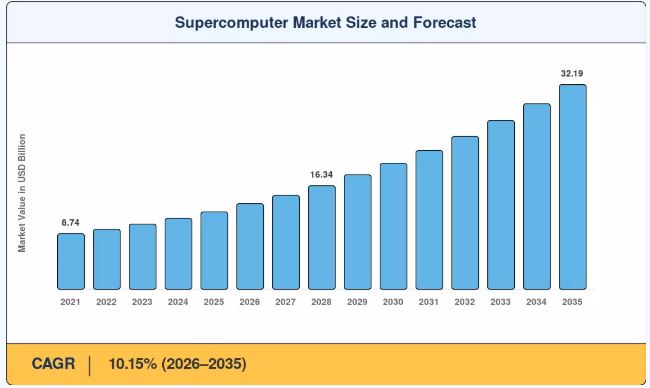
NEW YORK,, NY, UNITED STATES, June 25, 2026 /EINPresswire.com/ -- The Global Supercomputer market reached an estimated USD 12.22 billion in 2025 and is projected to climb to USD 32.19 billion by 2035, expanding at a 10.15% CAGR during 2026–2035. — Market Research Future (MRFR)
National exascale programs headlined by the US Department of Energy’s USD 1.8 billion investment in Frontier-class successors and the European High-Performance Computing Joint Undertaking’s EUR 7 billion commitment across 2021–2027 are the twin policy catalysts pushing procurement budgets to record highs. Meanwhile, the convergence of AI large-language-model training demand and digital-sovereignty mandates is broadening the buyer base for supercomputers far beyond traditional government laboratories, drawing in cloud hyperscalers, pharmaceutical companies, automotive OEMs, and financial institutions as significant new procurement stakeholders.
A generational technology shift is reshaping the supercomputer market at its architectural core. Accelerator-dense, liquid-cooled exascale platforms delivering orders-of-magnitude improvements in AI throughput are replacing legacy petascale designs built on general-purpose CPUs. GPU and custom ASIC accelerators now command the fastest-growing component segment, with cloud hyperscalers and pharmaceutical companies shifting investment from traditional CPU clusters to heterogeneous computing fabrics purpose-optimized for specific workloads.
This architectural transition is simultaneously raising average system value, compressing the performance gap between commercial cloud HPC-as-a-Service and on-premise installations, and reshaping competitive dynamics among the major system integrators competing for both government and enterprise contracts.
Get Full PDF Sample Copy of Report: (Including Full TOC, List of Tables & Figures, Chart) @
https://www.marketresearchfuture.com/sample_request/11554
➤ How Significant Is the Supercomputer Market’s Growth?
The supercomputer market’s trajectory from USD 12.22 billion in 2025 to a projected USD 32.19 billion by 2035 represents more than a two-and-a-half-fold expansion, driven by the simultaneous scaling of national government programs, enterprise adoption, and cloud-based HPC delivery models. The market’s 10.15% CAGR reflects both the extraordinary capital intensity of exascale infrastructure investment and the broadening of the addressable buyer base across commercial verticals.
Processors (CPU) accounted for 41.4% of supercomputer market revenue in 2025, reflecting their continued role as the orchestration backbone in hybrid computing architectures, while GPU and ASIC accelerators are forecast to expand at a 16.1% CAGR through 2035 the fastest among all component categories driven by the insatiable compute appetite of large-language-model training workloads. Exascale installations are accelerating at an exceptional 24.2% CAGR, cementing their status as the premium tier of the market.
Cloud-based HPC-as-a-Service recorded the fastest projected deployment CAGR of 18.4% through 2035, while healthcare and life sciences end-users registered the quickest vertical growth rate at 16.3%, propelled by genomics sequencing and AI-driven drug-discovery workloads requiring petabyte-scale data processing at sustained throughput.
➤ What Does the Future Hold for the Supercomputer Market?
AI and large-language-model training demand is the single largest near-term catalyst for supercomputer market expansion, contributing approximately 25% to the market’s CAGR. The US government established the National Artificial Intelligence Research Resource with a proposed USD 2.6 billion six-year budget to provide public researchers with access to advanced computational infrastructure, while private hyperscalers have committed hundreds of billions in AI compute infrastructure globally. Training frontier foundation models now demands sustained exaflop-scale compute over weeks, making purpose-built AI supercomputer clusters an essential capital investment category for every technology company pursuing competitive AI capabilities.
National exascale and sovereign-compute investment programs are establishing guaranteed multi-year procurement floors across the world’s largest economies. The European High Performance Computing Joint Undertaking’s EUR 7 billion allocation across 2021–2027 is funding next-generation pan-European petascale and pre-exascale installations at computing centers in Finland, Italy, Luxembourg, the Czech Republic, and Spain.
Japan’s follow-on to the Fugaku supercomputer the world’s fastest machine as recently as 2020 is advancing under government roadmap investment, while India’s National Supercomputing Mission is commissioning 70 high-performance computing facilities across IITs and national research institutions. China’s domestic chip-development programs are driving sovereign exascale ambitions independent of US semiconductor supply chains.
Healthcare, genomics, and climate simulation workloads are establishing the supercomputer market’s most durable and diversified commercial demand base. The US Department of Energy’s Advanced Scientific Computing Research program requested USD 1,152.7 million for fiscal year 2025, funding complex biological modeling, pandemic readiness simulations, and materials science workloads that collectively define a growing non-defense government procurement category.
Population-scale genomics programs including the UK Biobank’s 500,000-participant whole-genome sequencing initiative and the NIH All of Us program require sustained petaflop-scale compute that is migrating from national labs to specialized healthcare supercomputer facilities embedded within major academic medical centers.
➤ Who Are the Key Players in the Supercomputer Market?
The supercomputer market is served by a concentrated group of system integrators, accelerator silicon providers, and specialized HPC technology companies that compete across government, research, and commercial enterprise segments. MRFR identifies the following key participants:
✦NVIDIA Corporation — the dominant AI accelerator and GPU supplier whose H100 and H200 Hopper-generation and Blackwell-generation chips power the majority of the world’s top AI supercomputers, with the DGX SuperPOD and DGX Cloud platforms providing turnkey supercomputing infrastructure for government labs and enterprise AI programs.
✦Hewlett Packard Enterprise (HPE) — the largest supercomputer system integrator by installed base, building and operating frontier-class exascale systems including the US Department of Energy’s Frontier supercomputer at Oak Ridge National Laboratory — the world’s first confirmed exascale system — through its Cray EX platform and HPE Slingshot interconnect technology.
✦IBM Corporation — a long-standing supercomputer and HPC technology pioneer, providing Power-architecture processors, Summit and Sierra-generation systems at DOE national laboratories, and growing investments in quantum-classical hybrid computing platforms that are expected to complement classical supercomputer architectures.
✦Fujitsu Limited — the developer of the Fugaku supercomputer — Japan’s flagship ARM-based supercomputer that held the world’s top performance ranking — and a major supplier of supercomputer hardware and services to Japanese government research institutions and commercial life sciences organizations.
✦Lenovo Group Limited — a major supercomputer system integrator and the world’s largest provider of HPC systems by unit volume, with significant installed base across European and Asian academic and research institutions, offering the ThinkSystem SR series and Neptune liquid cooling technology.
✦Dell Technologies Inc. — a major provider of HPC cluster systems and supercomputer infrastructure for research institutions, government agencies, and commercial enterprises, offering PowerEdge server platforms integrated with NVIDIA GPU accelerators and high-speed interconnect fabric for AI and simulation workloads.
✦Advanced Micro Devices, Inc. (AMD) — a leading provider of high-performance CPU and GPU accelerator silicon for supercomputing, with EPYC processors serving as the compute backbone of multiple top-ranked systems and Instinct GPU accelerators competing directly with NVIDIA for AI training and inference workloads in HPC environments.
✦Atos / Eviden — a European HPC system integrator and operator of the BullSequana supercomputer platform, serving major EuroHPC Joint Undertaking installations and providing sovereign, EU-designed supercomputing infrastructure to national research organizations across France, Germany, and wider Europe.
Competitive dynamics in the supercomputer market are increasingly shaped by the race to integrate the most powerful GPU accelerator silicon into system architectures, the ability to deliver liquid cooling infrastructure capable of managing megawatt-scale power densities, and strategic positioning within government procurement programs that represent multi-year, multi-hundred-million-dollar contract opportunities.
➤ What Are the Emerging Trends in the Supercomputer Market?
Several transformational trends are redefining the supercomputer market’s evolution through 2035:
AI & LLM Training as the Primary Demand Driver: The global AI foundation model training race has established sustained exaflop-scale compute demand as the supercomputer market’s fastest-growing procurement category. US government investment through the National AI Research Resource, combined with private hyperscaler AI infrastructure commitments, is ensuring that AI workloads remain the market’s primary growth engine through the forecast decade.
National Exascale & Sovereign Compute Programs: Government-led exascale infrastructure investment including the US DOE’s USD 1.8 billion Frontier successor program, the EuroHPC JU’s EUR 7 billion commitment, Japan’s Fugaku successor roadmap, and India’s National Supercomputing Mission is establishing guaranteed multi-year procurement pipelines that anchor the market’s growth floor across all major economies.
Accelerator-Dense Heterogeneous Architectures: GPU and custom ASIC accelerators are displacing general-purpose CPUs as the primary performance engines in modern supercomputer designs, with GPU/ASIC components forecast to expand at a 16.1% CAGR through 2035. This architectural shift is simultaneously raising average system value, increasing NVIDIA’s and AMD’s strategic importance to the market, and reshaping the competitive dynamics among system integrators.
Cloud HPC-as-a-Service Democratization: Cloud-based supercomputing delivery models led by AWS, Microsoft Azure, and Google Cloud through their high-performance computing instance families and dedicated GPU cluster services are achieving the fastest deployment CAGR at 18.4% through 2035, enabling mid-market pharmaceutical, financial, and engineering enterprises to access supercomputer-class performance without capital equipment procurement cycles.
Quantum-Classical Hybrid Architectures: IBM, Google, and IonQ are advancing quantum processors that are expected to complement classical supercomputer architectures for specific optimization, simulation, and materials science workloads by 2030. National laboratories and leading pharmaceutical companies are investing in quantum-classical hybrid computing research programs that represent a significant long-term expansion opportunity beyond the classical supercomputer market boundary.
Energy Efficiency & Liquid Cooling Infrastructure: As exascale systems consume multi-megawatt power budgets the US Frontier supercomputer draws approximately 21 megawatts at full load — direct liquid cooling, immersion cooling, and waste-heat recovery infrastructure are becoming critical differentiators in system procurement decisions. Energy efficiency regulations in Europe and power-grid constraints at national lab sites are accelerating the adoption of advanced thermal management technologies across the market.
Get access to the full description of the report @
https://www.marketresearchfuture.com/reports/supercomputer-market-11554
➤ How Is the Supercomputer Market Segmented?
The supercomputer market report provides a comprehensive segmentation framework:
By Type: Vector Processing Machines, Tightly Connected Cluster Computer, Commodity Cluster
By End User: Commercial Industries, Government Entities, Research Institutions
By Application: Cloud Infrastructure, Commercial, Space & Research Centers, Hospitals & Laboratories, Government Entities, Defense, BFSI
By Component: Processors (CPU), Accelerators (GPU/ASIC), Memory & Storage, Interconnect & Networking
By Deployment: On-Premise/Dedicated, Cloud-Based HPC-as-a-Service, Hybrid
By Region: North America, Europe, Asia-Pacific, Rest of the World
➤ What Are the Regional Insights from the Supercomputer Market?
North America dominates the global supercomputer market with approximately 38.2% of worldwide revenue in 2025, underpinned by US Department of Energy national laboratory procurement, DARPA and defense agency investment in high-performance computing for national security simulations, and the concentration of hyperscale AI infrastructure investment from Google, Microsoft, Meta, and Amazon.
The US government’s USD 2.6 billion National AI Research Resource commitment and the DOE’s continued exascale investment program including Frontier-class successor procurement are establishing sustained government demand that complements the private sector’s AI supercomputer buildout.
Europe holds the second-largest regional share at approximately 26.5%, driven by the EuroHPC Joint Undertaking’s EUR 7 billion installation program and strong demand for automotive crash simulation, climate modeling, and pharmaceutical drug discovery supercomputing from Germany, France, the United Kingdom, and Italy. European national computing centers — including Germany’s Jülich Supercomputing Centre, France’s GENCI, and Italy’s CINECA — are deploying next-generation petascale and pre-exascale systems under the EuroHPC framework, while the UK’s upcoming successor to the ARCHER2 national research supercomputer is advancing under UKRI funding.
Asia-Pacific is the fastest-growing region at a projected 13.4% CAGR through 2035, the highest of any region globally, fueled by China’s domestic exascale chip development programs advancing independently of US semiconductor export controls, Japan’s government-backed roadmap for a Fugaku successor targeting 100+ exaflop performance, and India’s National Supercomputing Mission commissioning 70 HPC facilities across academic and research institutions. South Korea’s Institute for Advanced Computation and the Korea Institute of Science and Technology are also expanding national HPC capacity as part of the country’s broader digital sovereignty strategy.
The Rest of the World segment, encompassing South America, the Middle East, and Africa, represents an emerging growth frontier for the supercomputer market, with adoption driven by sovereign compute programs in Saudi Arabia and the UAE, government investment in national research infrastructure in Brazil, and growing demand for HPC in oil & gas reservoir simulation, financial modeling, and genomics research across these regions. While currently representing a smaller share of global revenue, rising government investment in digital infrastructure and increasing participation in international research programs are expected to support above-average growth rates through 2035.
➤➤➤ Regional & Country-Level Reports by Market Research Future:
Supercomputer Market -
https://www.marketresearchfuture.com/reports/us-supercomputer-market-17235
➤➤➤ Industry Analysis Reports by Market Research Future:
Signaling Analyzer Market
https://www.marketresearchfuture.com/reports/signaling-analyzer-market-4464
Thermal Printing Market
https://www.marketresearchfuture.com/reports/thermal-printing-market-9754
Smart Led Lighting Market
https://www.marketresearchfuture.com/reports/smart-led-lighting-market-10117
Harmonic Filter Market
https://www.marketresearchfuture.com/reports/harmonic-filter-market-10178
Rf Semiconductor Market
https://www.marketresearchfuture.com/reports/rf-semiconductor-market-10921
Kiosk Market
https://www.marketresearchfuture.com/reports/kiosk-market-11358
Semiconductor Laser Market
https://www.marketresearchfuture.com/reports/semiconductor-laser-market-12543
North America 4 Inches Semi-Insulating Silicon Carbide Wafer Market
https://www.marketresearchfuture.com/reports/north-america-4-inches-semi-insulating-silicon-carbide-wafer-market-16159
Vco Oscillators Market
https://www.marketresearchfuture.com/reports/vco-oscillators-market-18823
Non-Dispersive Infrared Market
https://www.marketresearchfuture.com/reports/non-dispersive-infrared-market-22108
Sagar Kadam
Market Research Future
+1 628-258-0071
email us here
Legal Disclaimer:
EIN Presswire provides this news content "as is" without warranty of any kind. We do not accept any responsibility or liability for the accuracy, content, images, videos, licenses, completeness, legality, or reliability of the information contained in this article. If you have any complaints or copyright issues related to this article, kindly contact the author above.
